
When you're trying to identify carpenter ants, you'll want to focus on specific physical traits that set them apart from other insects. Their heart-shaped heads and segmented antennae can be key indicators, as well as their size, which ranges from 4 to 20 mm. While colors can vary, understanding their unique body shape and structure is essential. But there's much more to know about their nesting habits and behaviors that can help you spot an infestation before it becomes a problem. Curious about the signs that might indicate they're nearby?
Key Takeaways
- Carpenter ants have heart-shaped heads and 12-segmented antennae with an elongated terminal segment, lacking a club.
- They typically range from 4-13 mm in size, with black, red, brown, or yellow color variations.
- Look for signs of nesting, such as small piles of sawdust near wooden structures and ants emerging from walls.
- Carpenter ants are nocturnal and create foraging trails, often leading to food sources hundreds of feet away.
- Distinguish them from termites by their narrow waist, bent antennae, and clean nesting habits compared to termites' mud galleries.
Physical Characteristics
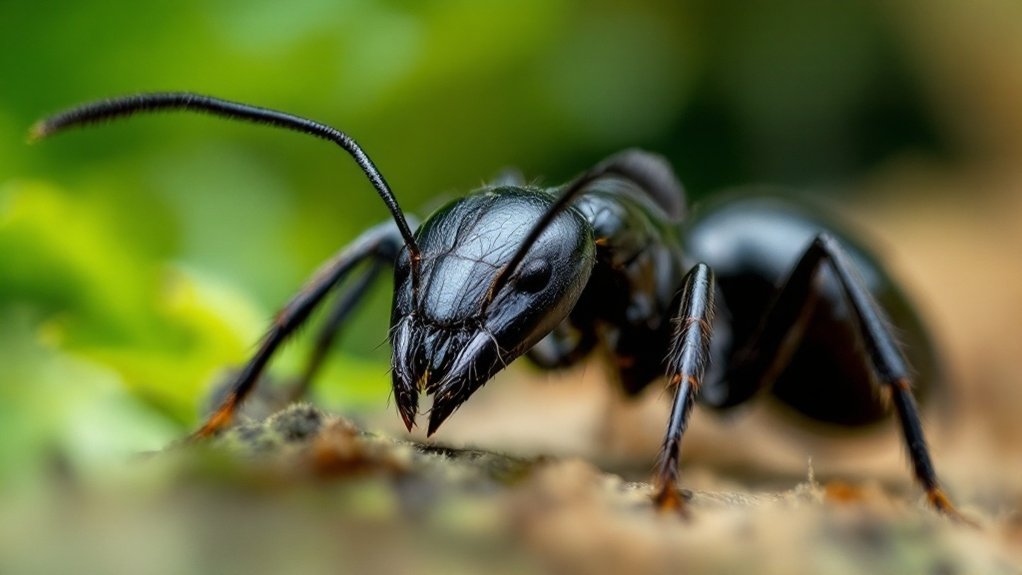
Carpenter ants exhibit distinct physical characteristics that set them apart from other ant species. One notable feature is their antennae structure, which consists of 12 segments. The terminal segment is slightly elongated and bullet-shaped, lacking a club, allowing for enhanced tactile sensitivity.
The head shape is heart-shaped, providing a unique silhouette that aids in identification. Workers vary in size, with lengths ranging from 4 to 7 mm in smaller species and 7 to 13 mm in larger ones, while queens can reach 20 mm. This size variation reflects the polymorphism among worker ants.
The thorax is another defining aspect; it's evenly convex and smoothly rounded when viewed from the side, forming a continuous curve from the pronotum to the propodeum. Additionally, carpenter ants possess a single petiolar segment that connects the abdomen and thorax, further distinguishing them from other species.
A circular ring of hair is present at the end of the abdomen, adding to their unique appearance. With these physical traits, understanding the antennae structure and head shape is essential for accurately identifying carpenter ants in their natural habitat.
Color Variations
How can you accurately identify the color variations of carpenter ants? These insects exhibit a range of color patterns that can complicate identification. Common colors include black, red, brown, and yellow, with some species displaying combinations, such as red and black or dark brown and black.
For instance, black carpenter ants are typically uniform in dark brown or black, while red carpenter ants feature dark bodies with a reddish-brown thorax. Regional differences further influence coloration. In Ohio, you'll likely encounter entirely black carpenter ants with fine whitish or yellowish hairs on their abdomens. Conversely, in Canada, red carpenter ants present dark brownish-black bodies with a reddish-brown upper body, while black carpenter ants appear uniformly dark brownish-black.
It's important to note that color isn't a definitive characteristic for identification. Variations can occur within colonies and different species may share similar color patterns. Carpenter ants can be challenging to identify due to their diverse color variations. As a result, evaluating body shape and antenna structure alongside color is essential for accurate identification. Given these complexities, professional identification may be necessary for precise species determination.
Size Comparison

Identifying carpenter ants involves more than just recognizing their color variations; size is a significant factor as well. The size range of carpenter ants varies considerably, with workers measuring between 6 mm and 13 mm, while queens can reach up to 20 mm. This size variation is particularly pronounced among the worker caste, which includes both minor and major workers, the latter serving as soldiers.
Consider these key size comparisons:
- Larger than typical ants: Carpenter ants are generally bigger than pavement ants, which are only about 3 mm long.
- Winged swarmers: Males can grow up to 18 mm, showcasing the size difference in the reproductive phase.
- Distinct from other species: Unlike odorous house ants, carpenter ants exhibit notable size and behavioral differences.
- Not the largest: While they're relatively large, species like *Dinoponera* can exceed lengths of 1.5 inches (3.8 cm).
Additionally, carpenter ants can be identified by their irregular galleries in wood, which are smooth and sculpted, further aiding in their identification.
Understanding these size differences can aid in accurately identifying carpenter ants, especially given the polymorphic nature of worker variation within their colonies.
Nesting Habits
Nestled within decayed wood, carpenter ants establish their nests in environments that provide ideal conditions for their survival. Their nesting preferences lean heavily toward damp, decayed wood, typically with a moisture content exceeding 15 percent.
You'll often find these nests in both hardwoods and softwoods, particularly in dead or decaying tree stumps, logs, and branches. Moisture requirements play a vital role; they target wood weakened by moisture, especially around skylights, chimneys, and window frames.
Carpenter ants construct two types of nests: parent nests and satellite nests. The parent nest, usually found in moist wood, houses the queen and her eggs, while satellite nests are located in drier, warmer areas. These may include hollow doors, curtain rods, or insulation voids.
As they excavate, carpenter ants create smooth, sculpted galleries, pushing sawdust outside, which often appears as small piles near entry points. National parks provide excellent habitats for observing these nesting behaviors in their natural environments.
To locate their nests, inspect indoor and outdoor areas for signs of activity, such as sawdust piles. Following foraging ants, especially at night, can also lead you to their nests, enhancing your understanding of their nesting habits.
Common Locations
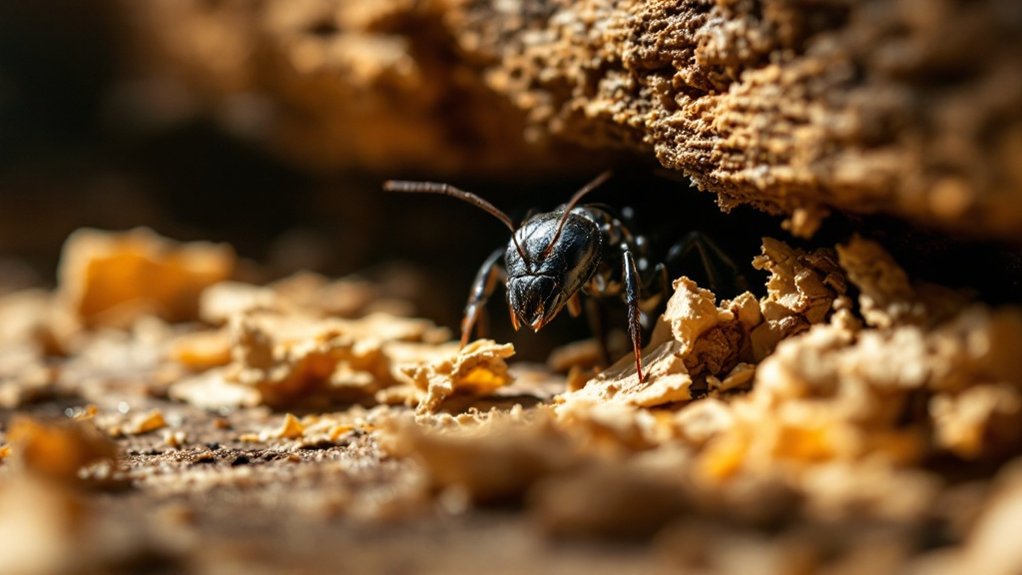
Carpenter ants are often found in a variety of locations that provide the moisture and structural conditions they prefer for nesting. They commonly engage in outdoor nesting within moist or decaying wood, which is essential for their colony survival.
You might encounter their nests in:
- Trees, tree stumps, and tree roots
- Logs and other wood debris
- Wooden fences, decks, and landscape plants
Indoors, carpenter ants seek out damp environments, often near water sources. They can establish nests in:
- Wall voids, insulation, and beneath floorboards
- Areas around dishwashers and bath traps
- Hollow spaces near sinks, chimneys, and windows
Specifically, look for nests in wooden shingles, porch posts, and window frames. It is important to note that they typically prefer to nest in moist or decaying wood, as it provides the ideal conditions for their colonies.
Carpenter ants can also exploit cracks and crevices to extend their outdoor nesting sites into your home. Areas like window and door frames, skylights, and even small voids between door casings are often targeted.
Understanding these common locations can help you better identify potential nesting sites and take preventive measures against infestations.
Signs of Infestation
Signs of an infestation can manifest in various ways, alerting homeowners to the presence of carpenter ants. You may notice large ants, typically measuring 1/4 to 1/2 inch long, that range in color from black to red or orange. If you observe ants emerging from walls or ceilings, it's a strong indication of an indoor nest.
Look for piles of sawdust-like frass near wooden structures, comprised of wood shavings and ant body parts. Auditory signs also provide clues; faint rustling noises within walls often indicate ant movement. If you hear scratching sounds, it could be carpenter ants scraping wood particles as they burrow.
You should assess your property for visible trails leading between nests and food sources, especially along walls and foundations. Keep an eye out for smooth, hollowed-out galleries in wood, a sign of significant damage. Additionally, damaged wood may indicate ongoing carpenter ant activity, making it essential to investigate further.
Moisture-damaged wood attracts carpenter ants, making damage assessment critical for infestation prevention. If you encounter these signs, it's crucial to act swiftly to mitigate further damage and effectively manage the infestation.
Behavior and Activity
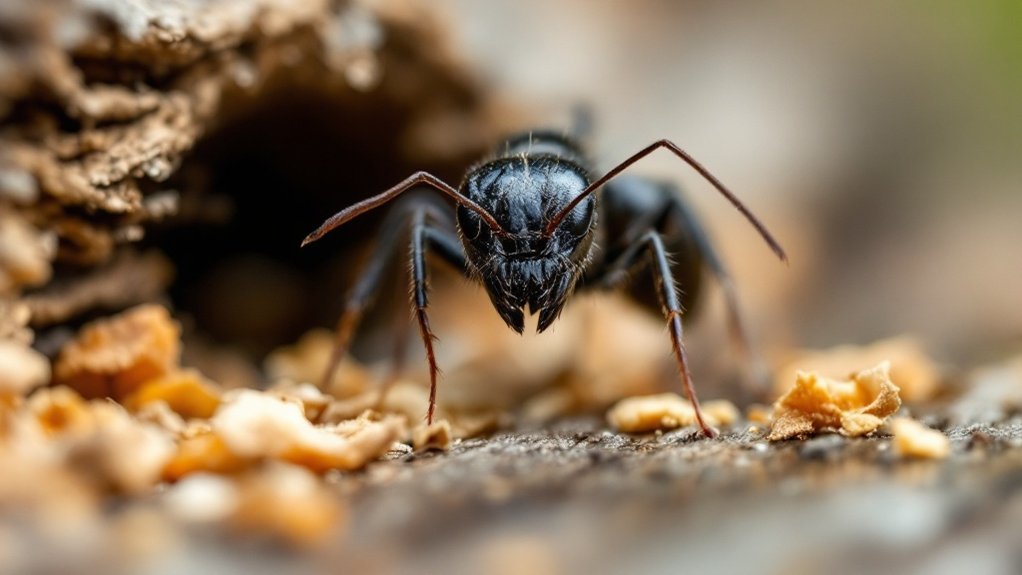
Understanding the behavior and activity of carpenter ants is essential for effective identification and management of an infestation. These insects exhibit distinct foraging patterns, primarily emerging at night due to their nocturnal habits. About 15 minutes after sundown, you'll notice a significant increase in activity as they leave their nests in large numbers to search for food.
Here are some key points about their behavior:
- Carpenter ants prefer nesting in damp or decaying wood, both indoors and outdoors.
- They build semi-permanent trails connecting nests to food sources, often traveling hundreds of feet.
- Their foraging peaks in the northeast during July, with activity intensifying from May to October.
- You may observe 10- to 20-fold more ants at night compared to daylight hours.
As they forage, carpenter ants feed on sugar, dead insects, honeydew from aphids, and plant exudates. Their nightly foraging not only helps them gather food but also facilitates the expansion of their colony, leading to the establishment of satellite colonies nearby. Furthermore, their foraging occurs in more humid conditions at night, which supports their survival needs.
Recognizing these behaviors is vital for managing potential infestations effectively.
Distinguishing From Termites
When it comes to distinguishing carpenter ants from termites, several critical physical and behavioral characteristics can help you make the identification.
Carpenter ants possess a narrow waist, bent antennae, and strong mandibles, while termites exhibit a uniform body width and straight antennae. Carpenter ants are generally larger, ranging from ½ inch to 1 inch, and display a segmented body structure that includes a distinct constriction at the waist. In contrast, termites are typically smaller, less than ½ inch, and exhibit a more uniform appearance.
Behavioral differences also play a role in identification. Carpenter ants create clean, polished nests within wood, leaving behind sawdust-like debris, whereas termites often produce mud galleries and pellets of frass. Additionally, carpenter ants typically nest in decaying wood rather than consuming it like termites do.
The ecological roles of these insects differ considerably as well; carpenter ants primarily focus on excavating wood for nesting, while termites consume wood, leading to structural damage.
To accurately distinguish between these two pests, observe their physical traits and the signs of infestation they leave behind. Understanding these differences will enable you to address any potential issues effectively.
Carpenter Ants Extermination
If you are worried about carpenter ants or other pest issues, My Pest Pros can help. Our expert ant exterminators and pest control experts will help to identify where your ant issues are coming from and create a treatment plan for ants or other pests. Contact us today to schedule an ant treatment at 703-665-4455.